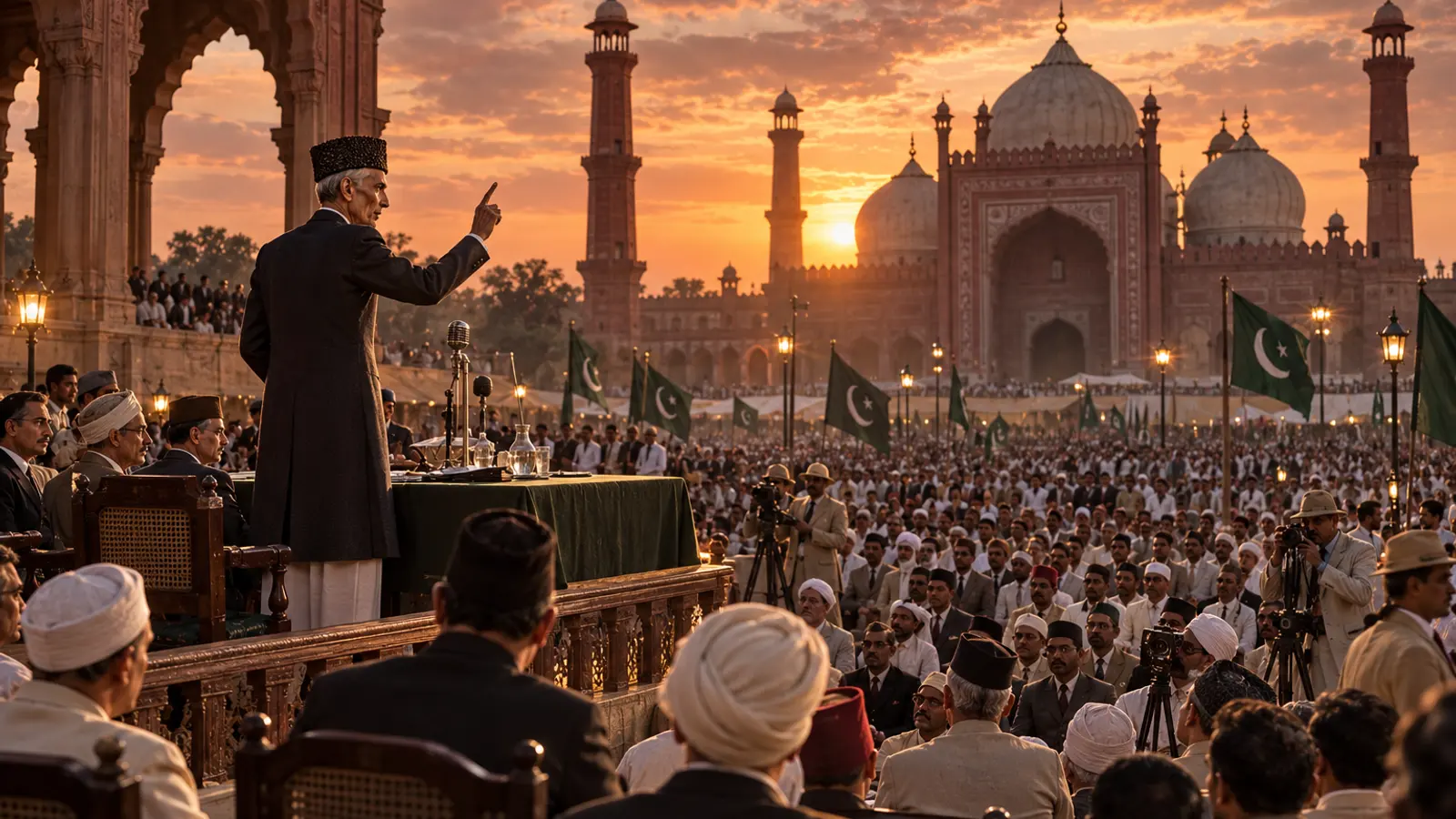
The Lahore Resolution
The road from Lucknow's unity to Lahore's separation ran through the 1937 elections. Congress swept the general seats, formed ministries in eight provinces, and saw no need to share office with a League it had trounced; Jinnah, rebuffed, toured the towns telling Muslims what he had come to believe — that under majority rule they would be a permanent minority in someone else's nation. When war came in 1939 the Congress ministries resigned in protest at India's conscription into it unconsulted, and the League observed a 'Day of Deliverance'. The two-nation argument now had its evidence, its audience, and its advocate.
At Minto Park in Lahore, on 23 March 1940, before a crowd of a hundred thousand, Jinnah declared that Hindus and Muslims were two nations by every test of history and law, and Bengal's premier Fazlul Huq — the Sher-e-Bangla, the Tiger of Bengal — moved the resolution: that the Muslim-majority zones of the north-west and east be grouped into 'independent states, autonomous and sovereign'. The word Pakistan appears nowhere in the text; the newspapers supplied it within days, and the name devoured the ambiguity. One state or several, federation or partition — the vagueness was the design, and it let every listener hear the promise he wanted.
History pressed the date with its own irony: nine years earlier to the day, in this same city, Bhagat Singh had been hanged dreaming of a republic with no room for the word 'communal'. From Lahore the demand ran seven short years to reality — the war that jailed the Congress and left the League the field, the 1946 elections it swept in the Muslim seats, Direct Action's blood, and the line Radcliffe drew. Read this plate and then the plates of 1946: the road between them is short, and terrible.