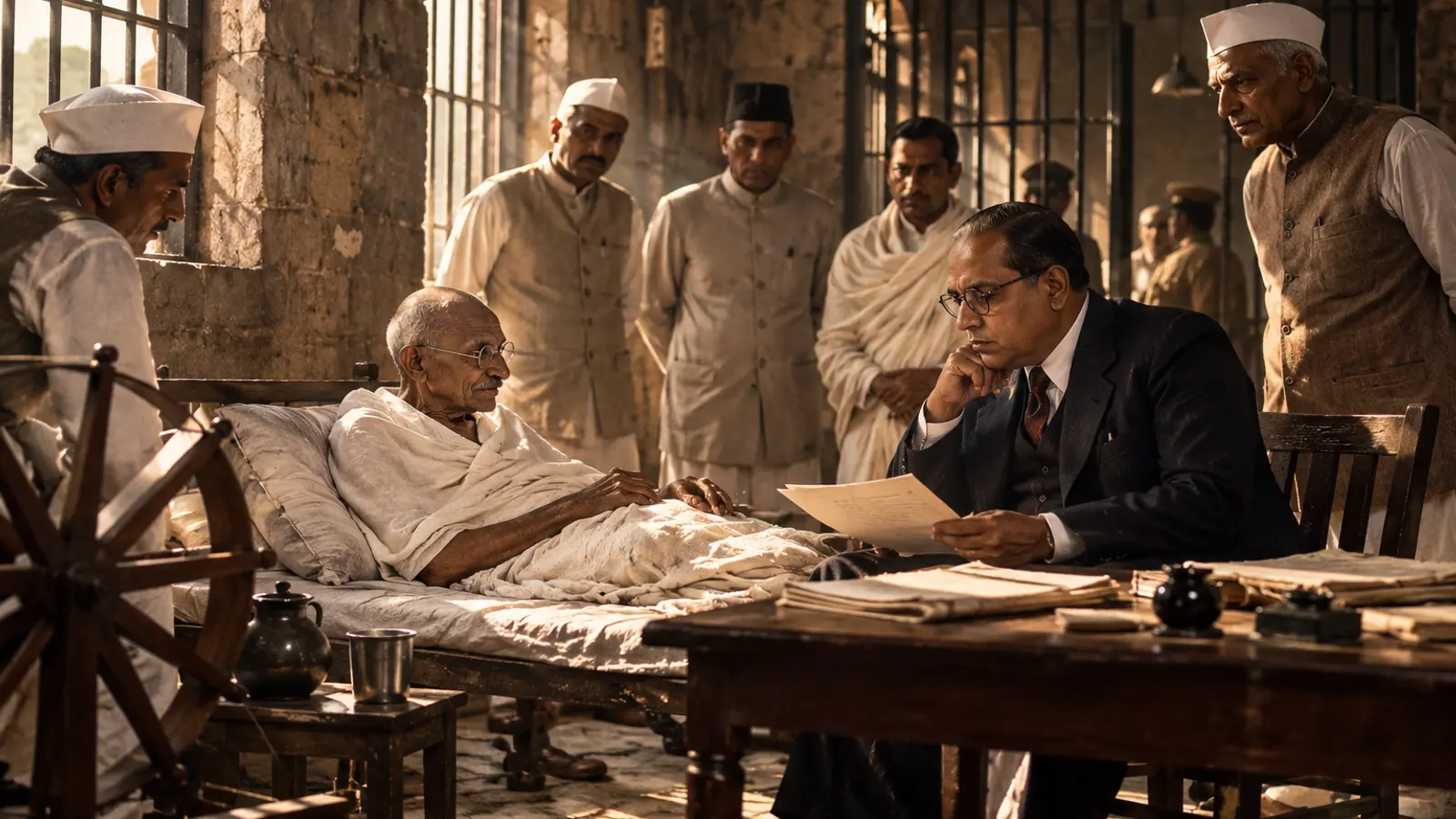
The Poona Pact
Bhimrao Ambedkar had come up through every door India tried to close on him — an 'untouchable' boy made to sit apart in school, who took doctorates at Columbia and London and returned a jurist without equal — and at the Round Table Conferences he put the case no Congressman wanted to hear: that the Depressed Classes were not a wing of Hindu society awaiting uplift but a people held in servitude by it, who needed political power of their own. In August 1932 Britain's Communal Award agreed, granting them separate electorates as it had Muslims. Gandhi, then a prisoner in Yerwada jail, declared that he would fast unto death against it.
Gandhi's objection was that separate electorates would vivisect Hindu society and wall the untouchables permanently out of it; Ambedkar answered that the fast was coercion aimed not at the Raj but at his people, held hostage to one man's conscience — and that if Gandhi died, it was Dalit villages that would burn. As the fast wore on and the country turned its fear on him, Ambedkar bargained from the jail courtyard for everything he could hold: on 24 September the Poona Pact was signed — separate electorates withdrawn, and in their place reserved seats for the Depressed Classes nearly doubled, chosen by joint electorates.
Both men gave up what they most wanted, and neither forgave the arithmetic. Gandhi turned to his Harijan campaign against untouchability itself; Ambedkar concluded that reserved seats under joint electorates gave his people members but not power, and went his own way — toward the labour movement, toward the Constitution of free India that he, of all men, would principally draft, and at the end of his life toward the Buddha, with half a million followers. This plate holds the struggle's deepest internal question, never fully answered: freedom for India — but on whose terms, and for whom?