Quit India
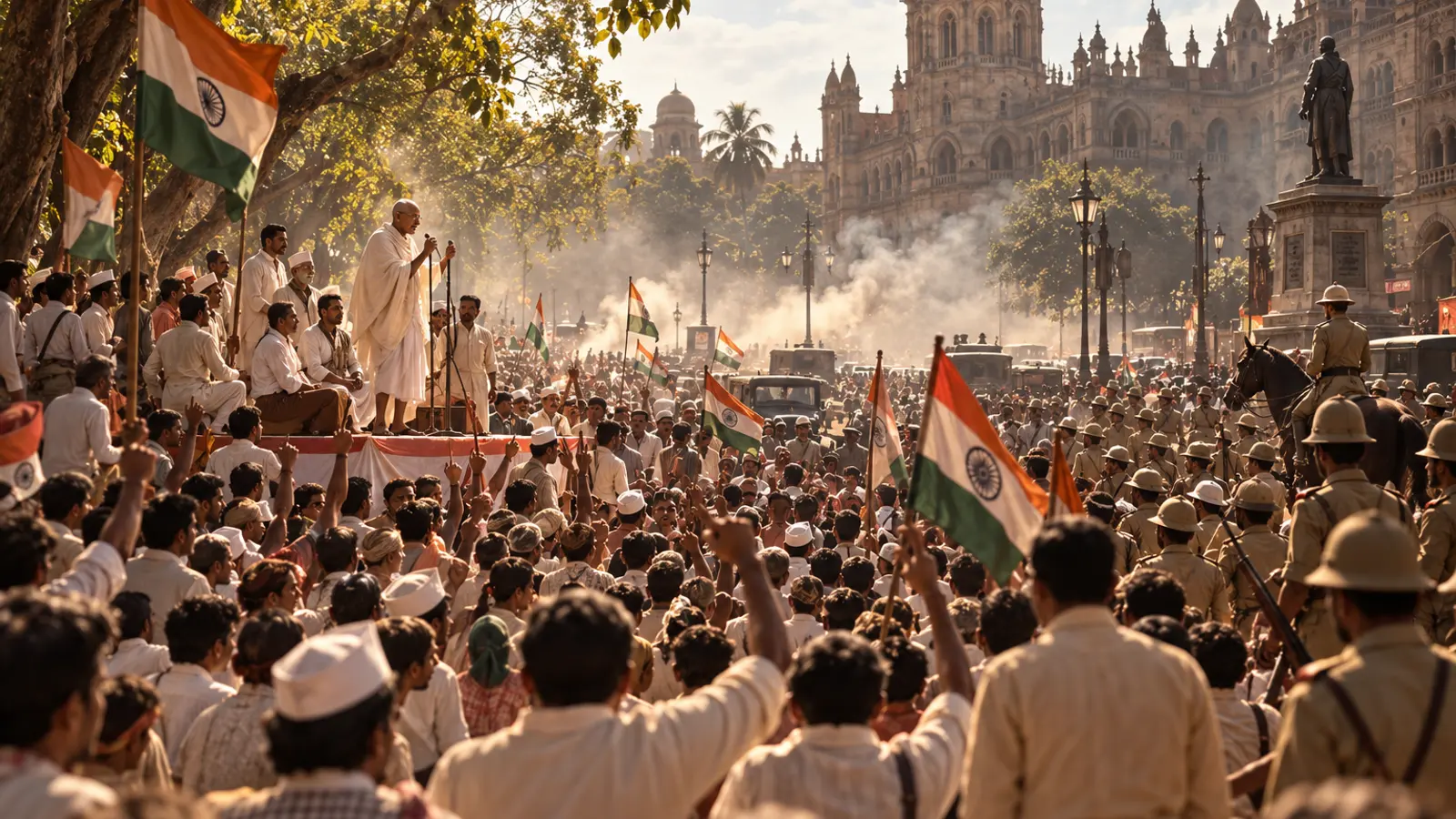
By 1942 the war Gandhi had refused to endorse was at India's doorstep — Singapore fallen, Burma lost, and the Cripps Mission's offer of postwar promises dismissed as 'a post-dated cheque'. On 8 August, at Gowalia Tank in Bombay, the Congress passed the Quit India resolution, and Gandhi gave the crowd a mantra of final defiance: 'Do or die.' We shall free India or die in the attempt.
The Raj struck before dawn. By morning Gandhi, Nehru, Patel, Azad — the entire leadership — were behind bars, where they would sit for the rest of the war. And then something unplanned happened: leaderless India rose anyway. Aruna Asaf Ali hoisted the tricolour over Gowalia Tank; railway lines were torn up, police stations burned, whole districts declared themselves free; Usha Mehta's clandestine Congress Radio broadcast until the police found the transmitter.
The repression was the fiercest since 1857 — mass floggings, aerial machine-gunning of crowds, perhaps ten thousand dead. The rising was crushed in months, but its meaning was unmistakable, and even Churchill's cabinet could read it: India could still be held by force, but it could no longer be governed. It was, as one historian wrote, the point of no return.