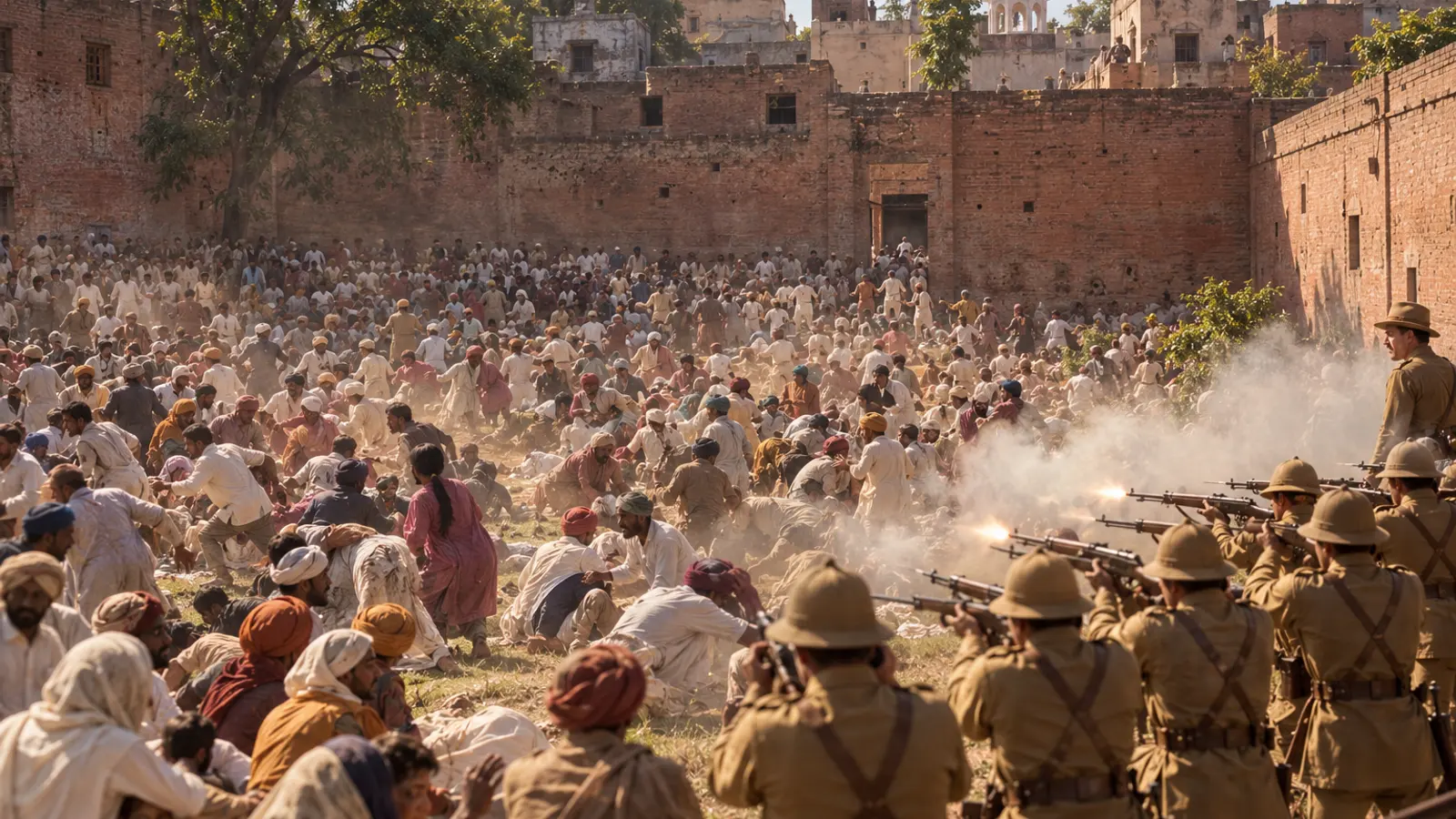
Massacre at Amritsar
The war was over, and India — which had sent a million men to fight for the Empire — was rewarded with the Rowlatt Act: peacetime powers of detention without trial. Gandhi called a nationwide hartal, and in Punjab the protests ran hot. In Amritsar, after days of unrest, gatherings were banned. On 13 April, Baisakhi day, thousands — pilgrims, villagers, families — filled Jallianwala Bagh, a walled garden with a handful of narrow exits.
Brigadier-General Reginald Dyer marched fifty riflemen through the main passage and, without a word of warning, ordered fire. For ten minutes the troops shot into the thickest of the crowd, 1,650 rounds, aiming where people scrambled at the walls and leapt into the well. The official count was 379 dead; Indian estimates ran close to a thousand. Dyer testified he had meant to produce 'a moral effect'.
He produced one. Tagore returned his knighthood, writing that the honour shamed him amid 'such mass humiliation'. Gandhi, who had recruited for Britain's war, concluded that cooperation with such a government was a sin. A Punjab orphan named Udham Singh waited twenty-one years, then shot Governor O'Dwyer dead in a London hall. Amritsar was the wound that never closed.