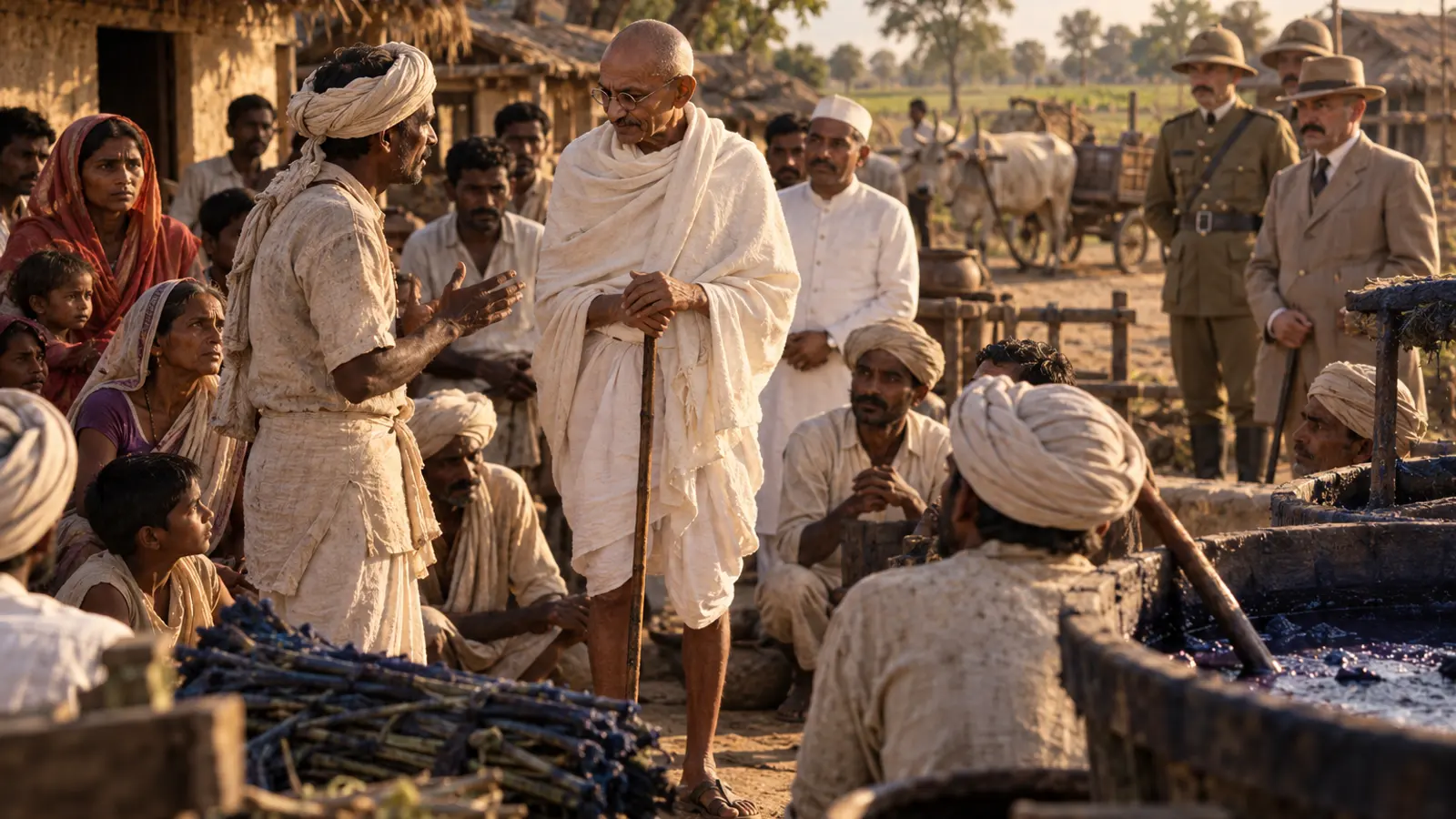
Champaran
In Champaran, in north Bihar, the indigo system the Blue Mutiny had killed in Bengal lived on: the tinkathia obliged every tenant to plant three-twentieths of his holding in indigo for the planter, at the planter's price, with the planter's men to enforce it. A ryot named Raj Kumar Shukla had decided that only one man could break it, and he pursued Gandhi across India — to the Lucknow Congress, to Kanpur, to Ahmedabad — with a patience that finally could not be refused. In April 1917 Gandhi stepped off the train at Motihari.
The district magistrate ordered him to leave; Gandhi declined, appeared in court, and pleaded guilty with a statement that he had come in obedience to a higher duty. Faced with a defendant asking to be punished and thousands of ryots standing quietly outside, the government blinked and withdrew the case — the first victory of civil disobedience on Indian soil. Then came the real work, conducted like a judicial inquiry: Gandhi and a band of young lawyers — Rajendra Prasad, J. B. Kripalani — recorded the sworn testimony of some eight thousand ryots, while Kasturba ran schools and sanitation in the villages.
The evidence was unanswerable. The Champaran Agrarian Act of 1918 abolished the tinkathia and refunded part of the planters' exactions, and the system that had survived sixty years of force fell to a ledger of affidavits. Gandhi had found his method's proof and his future lieutenants — one of them would be free India's first president — and India had found the instrument it would carry for thirty years: from Champaran through Kheda and Ahmedabad to the year 1920, when the whole country would be asked to say no together.