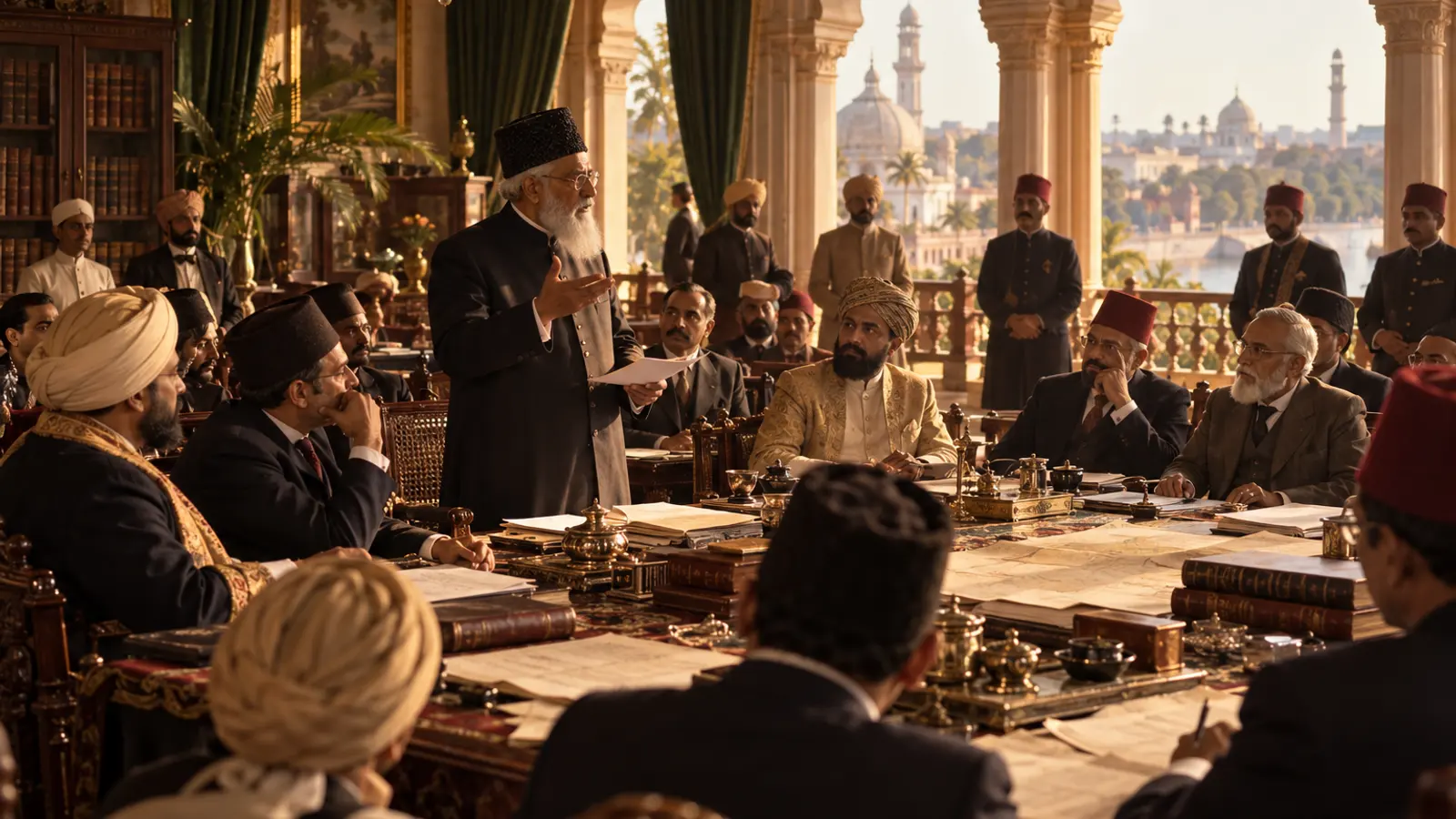
The League at Dacca
The partition of Bengal had given the Muslims of the east a province where they were the majority — and the Swadeshi agitation against it, with its conch shells and its hymn to the Mother, struck many Muslim leaders as a Hindu movement for Hindu ends. In October 1906 a deputation of thirty-five notables led by the Aga Khan waited on the Viceroy at Simla with a fateful request: that in any elected councils to come, Muslims should vote separately, for their own representatives, in proportion not merely to their numbers but to their 'importance'.
That December, when the annual Mohammedan Educational Conference met at Dacca, its host Nawab Salimullah proposed a permanent political body, and the All-India Muslim League was founded — impeccably loyalist in its first resolutions: devotion to the Crown, protection of Muslim interests, and no hostility intended toward any other community. Three years later the Morley-Minto reforms granted the Simla demand, and separate electorates entered India's constitutional bloodstream — a wedge whose consequences would unfold across forty years.
Yet nothing about the road from Dacca was straight. Within a decade the League, its leadership passing to younger lawyers, would sign a pact of unity with the Congress at Lucknow; the man who drafted it, a Bombay barrister named Jinnah, joined the League in 1913 while still a Congressman and an unbending Indian nationalist. Hold the two dates together — 1906 and 1940, Dacca and Lahore — and this archive's later plates show what the years between did to that beginning.