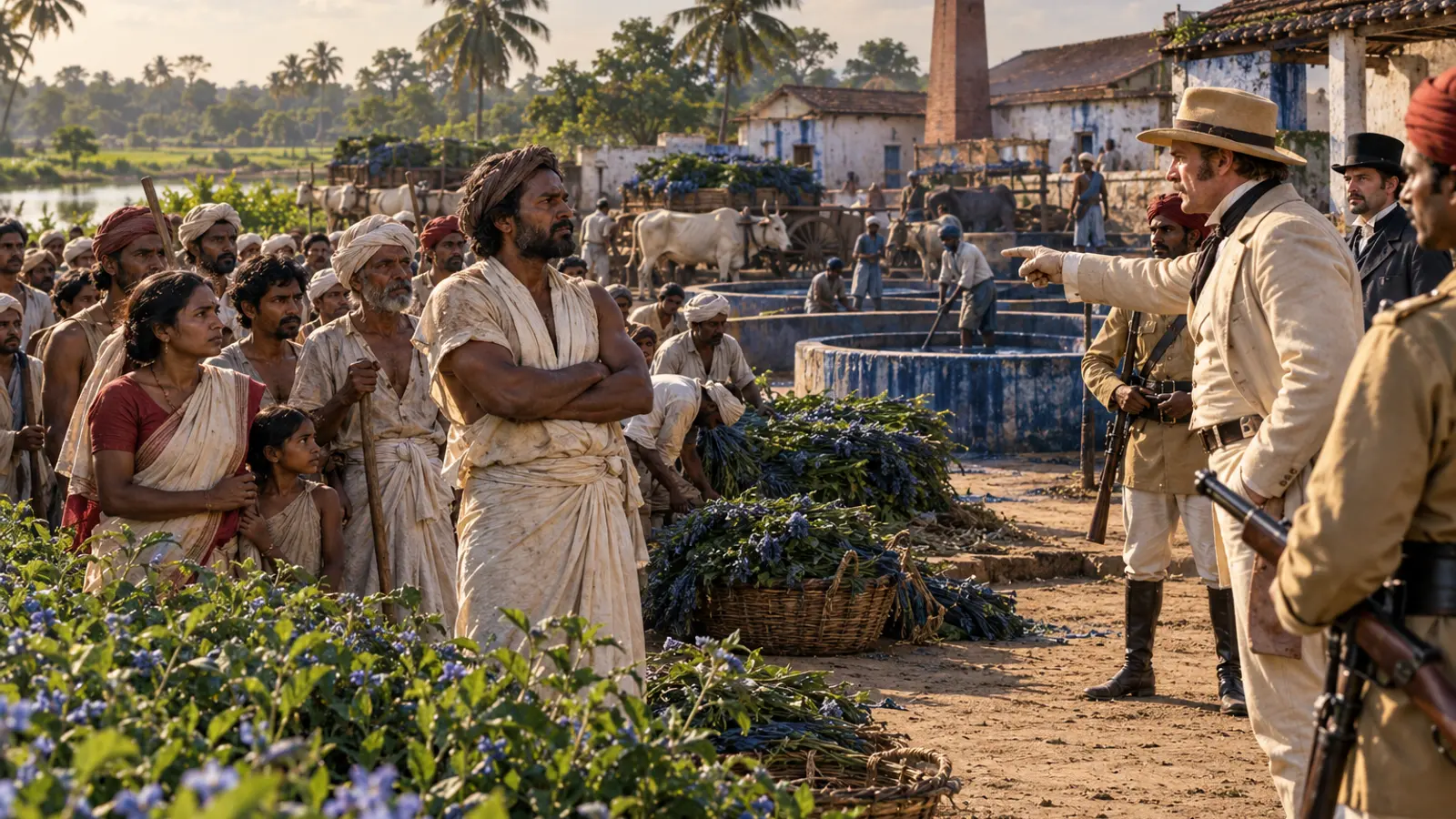
The Blue Mutiny
The indigo system of Bengal was slavery kept in ledgers. A planter's advance, once taken, could never be repaid: the ryot was bound to sow indigo on his best land at a price that guaranteed loss, and the factory's lathi-wielding enforcers dealt with those who refused — crops trampled, cattle seized, men flogged and carried off to the factory godowns. In 1859, in Nadia district, two village headmen named Digambar and Bishnucharan Biswas — former employees of the planters who knew the system from inside — organised their neighbours to refuse the advance and meet the factory's clubs with their own.
The refusal spread like water finding a level, from Nadia across Jessore, Pabna, and Faridpur — not a rising with banners but tens of thousands of cultivators simply declining, together, to sow. Harish Chandra Mukherjee's Hindoo Patriot carried the ryots' case week after week; missionaries testified to what they had seen; and the government, freshly shaken by 1857, appointed the Indigo Commission of 1860, before which even a planter's man admitted that the dye reached England stained with blood.
The verdict followed: no ryot could be compelled to sow. Planting collapsed in Bengal within a few years, and Dinabandhu Mitra's play Nil Darpan — the Indigo Mirror — carried the story to every stage in Bengal, its English translator, a missionary, going to jail for libel. The Blue Mutiny proved that organised refusal could beat European capital in its own courts — a lesson lying in wait for a lawyer who would reach Champaran's indigo fields fifty-eight years later.