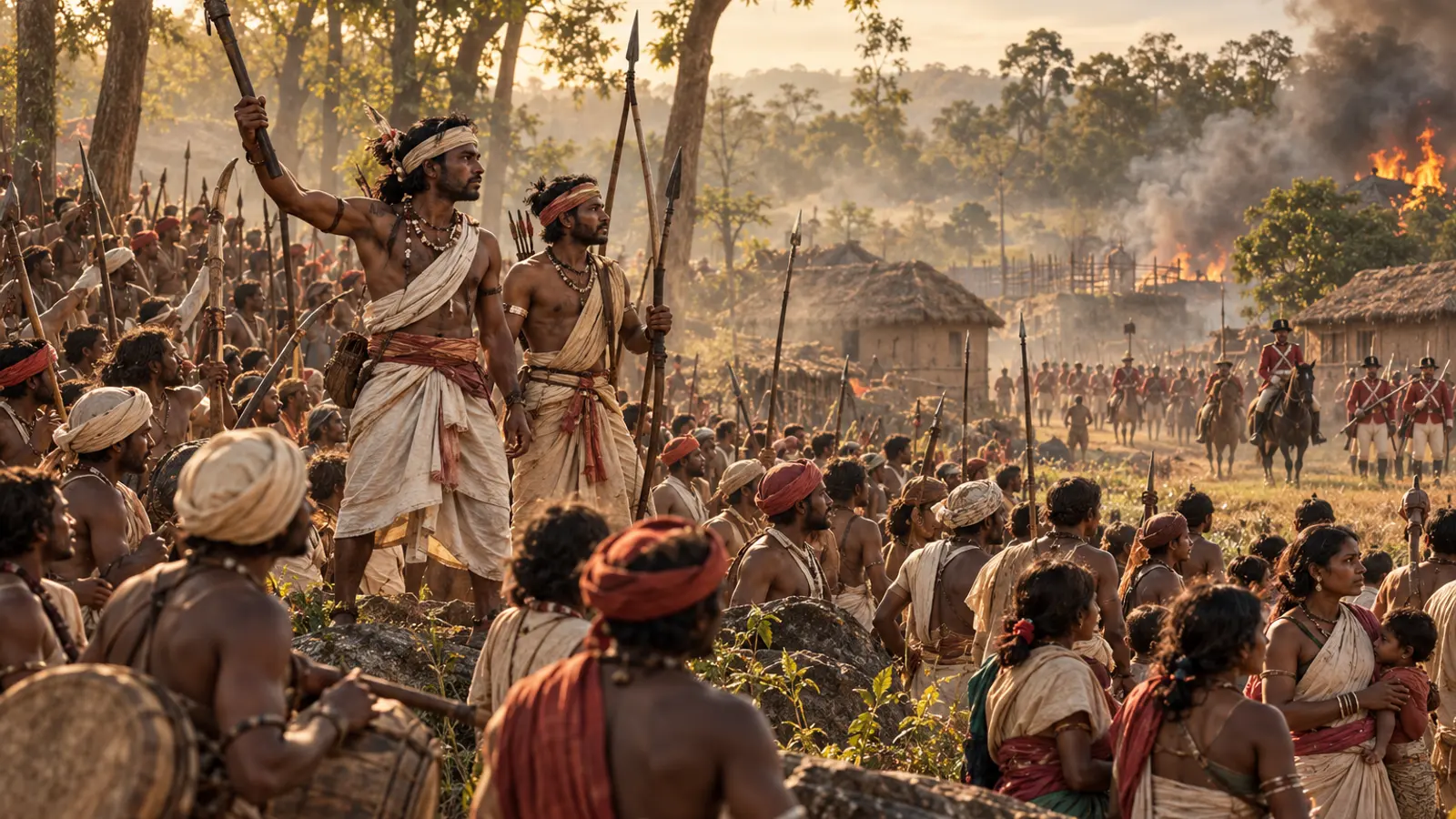
The Santhal Hul
The Company had invited the Santhals into the Damin-i-koh, the forested skirts of the Rajmahal hills, to clear and till it — then let loose upon them everything it called law. Mahajan moneylenders whose interest ran without end, zamindars' agents, false weights, and bond-labour that passed debt from father to son; and when a Santhal went to court, the court spoke the lender's language. On 30 June 1855, at the village of Bhognadih, some ten thousand Santhals gathered, and the brothers Sidhu and Kanhu Murmu declared that their god had commanded them to take back their country.
The Hul — the liberation — swept the hills. Armed with bows and battle-axes, the Santhals cut the Company's post roads and rail workings, executed the most hated usurers, and beat back the first small detachments sent against them, once driving off sepoys in open fight. The Company answered with martial law, elephants to flatten villages, and volley fire against bowmen. Perhaps fifteen to twenty thousand Santhals died; Sidhu was betrayed and hanged, Kanhu taken in arms; their sisters Phulo and Jhano passed into legend for carrying the fight themselves.
Even British officers wrote afterwards with unwilling awe that it had not been war as they knew it — the Santhals did not surrender, and died where they stood. Out of the carnage the Raj carved a separate district with protective tenancy rules, a template it would reuse after every tribal rising it provoked. Two years before the sepoys of Meerut, the countryside had already shown that the Company's peace rested on a floor of fire.