The Red Fort Trials
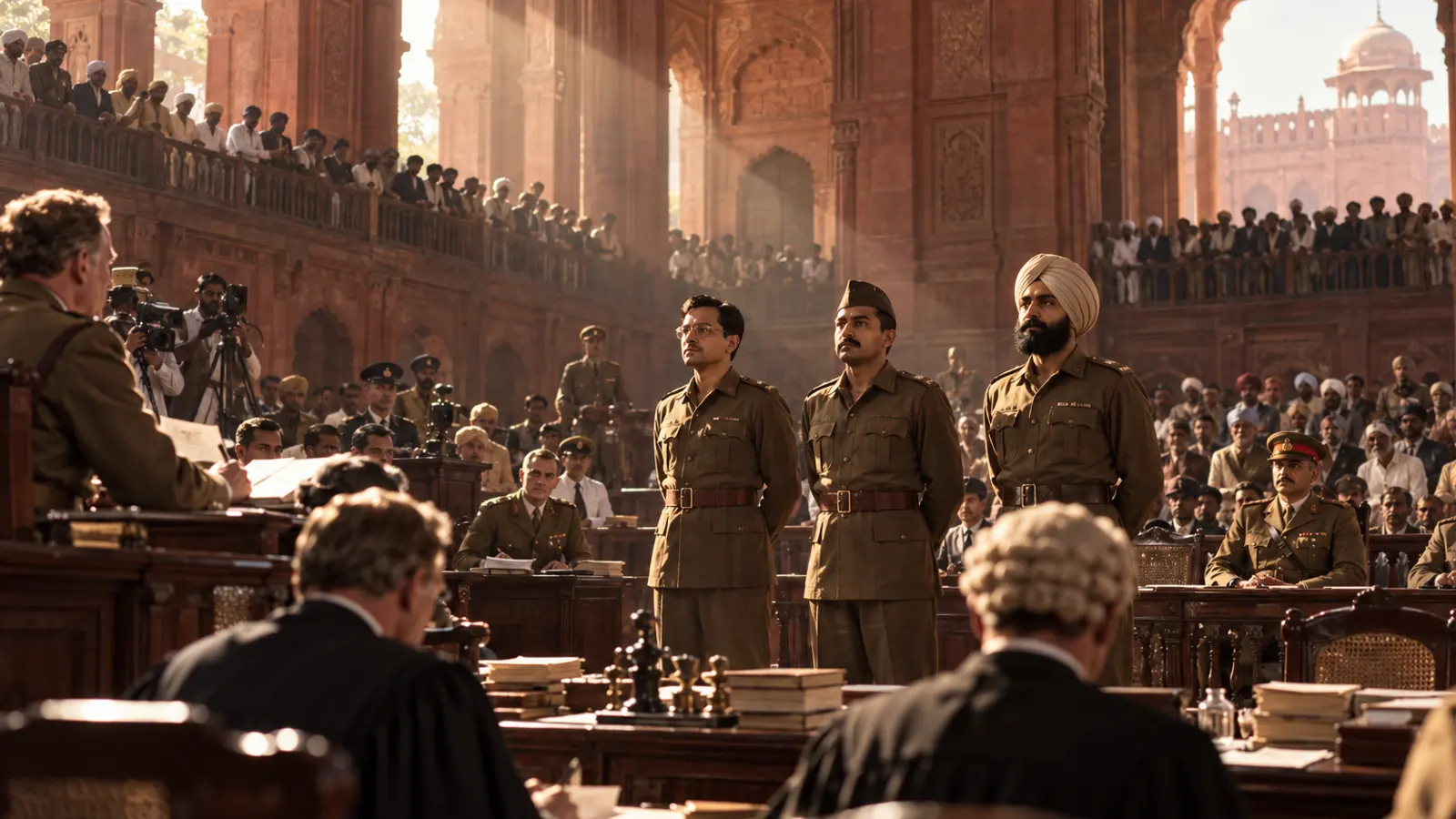
With the war won, Britain reached for the law to settle accounts with the Indian National Army — and committed one of the great blunders of its Indian career. For the first courts-martial it chose three officers to try jointly for waging war against the King-Emperor: Prem Kumar Sahgal, Gurbaksh Singh Dhillon, and Shah Nawaz Khan — a Hindu, a Sikh, and a Muslim, standing together in the dock. And for the courtroom it chose the Red Fort, seat of the Mughals, where the last emperor had been tried after 1857. The symbolism wrote itself, and all India read it.
The Congress raised a defence committee of the country's greatest lawyers — Bhulabhai Desai, who argued that a subject people carried the right to wage war for their liberation, Tej Bahadur Sapru, and Nehru himself, putting on his barrister's gown for the first time in a quarter of a century. In the streets the three defendants' names were chanted as one; Congress and the Muslim League, agreeing on almost nothing else, both demanded their release; serving soldiers in uniform slipped into the public galleries and contributed to the defence fund.
The court did its duty — guilty, transportation for life — and the Commander-in-Chief, Auchinleck, promptly remitted the sentences: his own commanders had warned him plainly that the Indian Army would not stomach their punishment. The three walked out of the fort to garlands and vast crowds. The trials had achieved what Bose's army never could in the field — they had carried the INA's cause into the heart of the army the Raj stood on, and within weeks the fleet itself would rise.