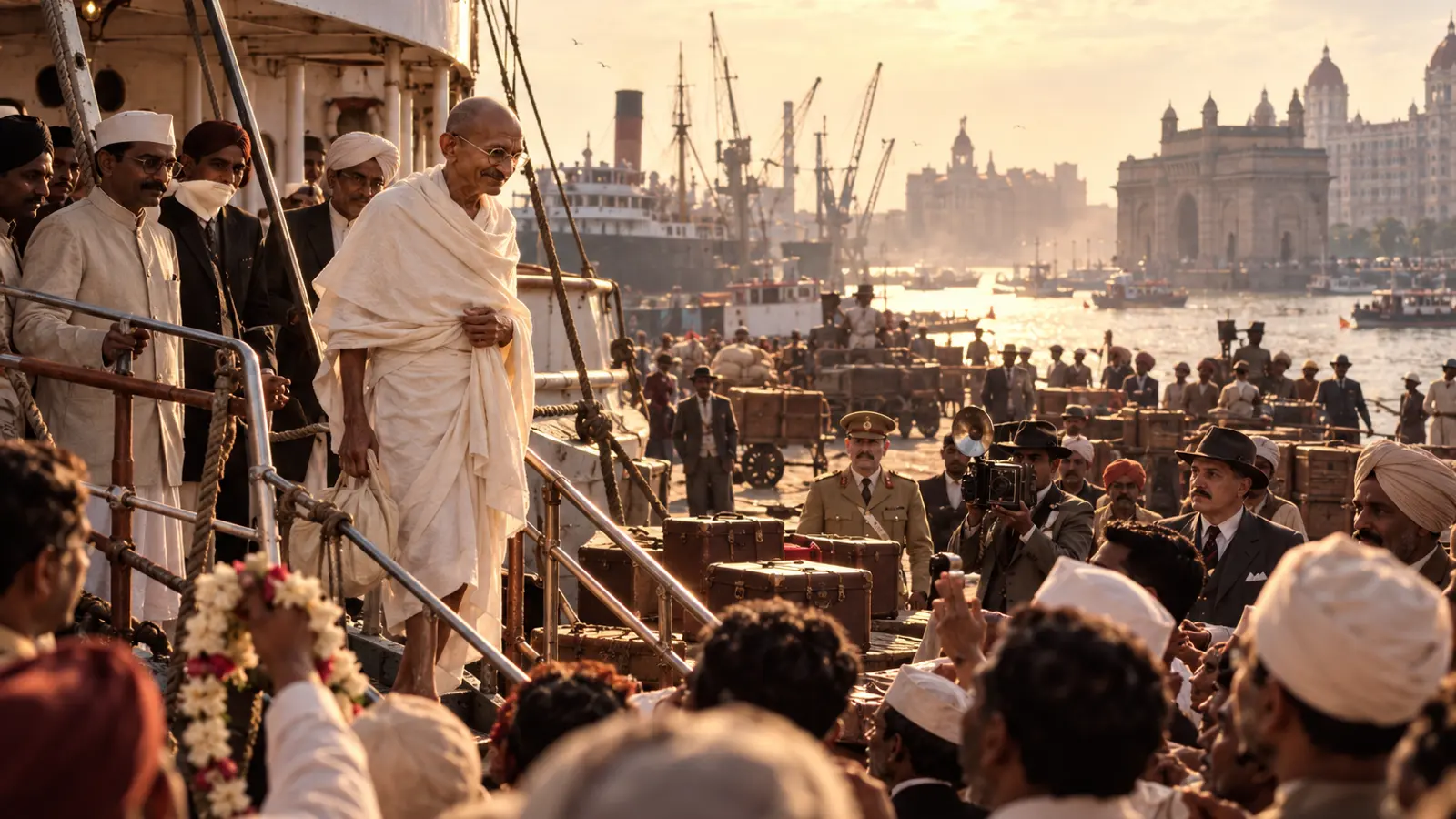
Gandhi Comes Home
The man who stepped off the S.S. Arabia at Apollo Bunder on 9 January 1915 was forty-five, dressed in a Kathiawari cloak and turban, and already famous. In South Africa, Mohandas Gandhi had led Indian labourers and traders through two decades of struggle against racial laws, and had forged there a new kind of weapon: satyagraha, 'truth-force' — mass civil resistance without violence, in which the resister accepts suffering rather than inflicting it.
His political mentor Gopal Krishna Gokhale extracted a promise: for one year, Gandhi would keep his mouth shut and travel India, third class, to see the country as it was. He saw it — the famines and the landlords, the indigo fields and the mill lines, an India the English-speaking Congress barely touched.
Then he went to work where no one else would: indigo sharecroppers in Champaran, mill hands in Ahmedabad, famine-struck peasants in Kheda. Each local fight was won with the same instrument — fearless, open defiance and a willingness to go to jail smiling. India had had orators and bomb-throwers. It had never had this.